Used with permission.
American Robin
(Genus, species: Turdus migratorius)
Each year, we've had a pair of robins build their nest and raise their chicks under the drain-spout of our roof. The cheerful singing of the male robins wakes us up each morning (though I must admit that the peeping of the chicks gets to be a bit much when they're waiting for breakfast).
Distribution/Location

General:
Most
of us don't have to wander far to bird watch if you're happy to watch
the American Robin. They're one of the first to arrive in spring
and happily hop along on front lawns searching for a meal of
worms.
The American Robin is a member of the Bluebird and Thrush family. It's called the 'American' robin because it was named after a similar (though smaller) bird found in Great Britain.

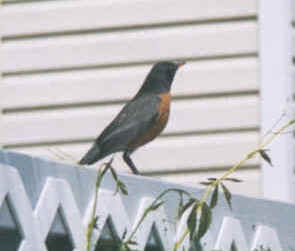
male
Used with permission.
©
Description - male:
The male robin's most striking feature is his red/orange
breast and belly. They have gray-brown back and tail
feathers with a slightly darker head. Their white throat
is streaked with black and their undertail
coverts are white.
They have brown legs and a thin yellow bill that they use for pecking worms and insects out of the ground.
Description - female:
The female robin's
coloring is quite similar to the male, but everything is a slightly paler
color.
Description - young:
The young robins also look similar, but have a heavily spotted breast.

Feeding:
The main diet of the American Robin is berries.
This is supplemented by insects, larva and worms.
The reason we see so many robins searching out worms is that worms and cutworms are the main diet of the chicks in the nest -- both parents are kept hopping to feed their hungry babies 100 meals each day!
At times, the robin will cock its head to the side toward the ground. It looks a bit like he's listening for the worms crawling under the ground, but really he's watching the ground for the tiny movements that would indicate a worm is traveling close to the surface.
Habitat:
Robins live in urban areas, forests, ranchlands and
roadsides.

Nesting:
Robins prefer to nest in spruce or maple trees, but are very
adaptable, nesting in all sorts of trees and buildings --
I've even seen one nest laid right in the middle of someone's
outdoor plant pot. They usually return to the same nesting
area each year and will reuse nests from previous years.
The female robin is in charge of nest construction. She takes 2 to 6 days to make the nest, using mud mixed with grass or small twigs. She uses her bill and feet to mould the nest into a cup shape and then adds a final lining of grass.

Photographer: Bates Littlehales
The female typically lays two clutches of eggs each year. Each clutch typically has 3 or 4 eggs (though they can have anywhere from 2 to 6).
The eggs, of course, are robin's egg blue -- they're one of the prettiest bird eggs around.
It takes about 2 weeks to incubate the eggs. During this time, the female sits on the nest while the male guards the area. Once in awhile the male will sit on the nest to give the female a break.
The young stay in the nest for about 15 days. Then they leave so the female can begin the second clutch.

Used with permission.
Enemies:
The
main enemy of the American Robin is the housecat -- our cat Sera can
attest to this. She's never caught one, but she spends hours
watching them out the window.
(see photo to the right)
Other enemies include bobcats, owls, hawks, crows, jays, snakes, squirrels, chipmunks and raccoon. Most of these enemies feed on the young or eggs, not the adult birds.
Migration:
Robins begin their return to nesting grounds each
spring in about February. They arrive in southern Canada in March
and in the more northern areas in mid-May. The males arrive at
their breeding grounds first with the females following about a week
behind.
Worksheets and Other Activities:
- Connecticut State Bird activity worksheet coloring page
- Michigan State Bird activity worksheet coloring page
- Wisconsin State Bird activity worksheet coloring page
- American Robin Coloring Page (from coloring.ws)
- "What I've learned about the American Robin" Coloring Worksheet
- Simple Robin Craft (it's meant for young children)
- Help the American Robin find his supper Maze
- How many words can you make from American Robin Word Worksheet