< BACK |
NEXT> |
Alberta Scenery Photo Tour
Alberta Wildlife:
Mammals
Of course, this is just a small sampling of Alberta wildlife. But it gives you a taste for what you might see if you visit.
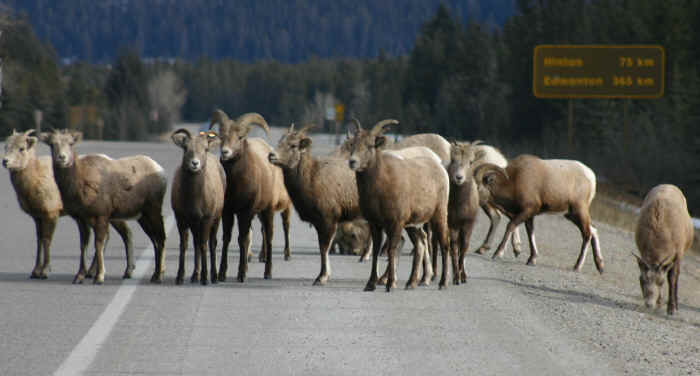
Photo: Bighorn Sheep
© Darren
Guenther, used with permission
In the Canadian Rockies there are 69 naturally occurring species of mammals. It is very common to see elk, deer, bighorn sheep (pictured in the photo), coyote and black bear throughout Banff and Jasper National Parks. However, wildlife have a mind of there own so you can never be sure what or if you'll see anything.
It is not appropriate to approach or feed the wildlife, but that does
not always prevent them from coming up to investigate you. As you
can see, it's also important to obey posted speed limits to prevent the
wildlife (and your vehicle) from being injured. You never know
when you'll turn a corner only to meet a herd of inquisitive bighorn
sheep (who never seem to be in much of a hurry to get out of the
way). The parks provide a very handy guide upon entering that
spell out safety rules and potential dangers when dealing with the
wildlife
Photo: Black Bear

The national parks (Banff National Park and Jasper National Park) in the Rocky Mountains are about an hours drive from the major cities in Alberta (Calgary and Edmonton).
I don't want to give people the impression that bears are walking around everywhere! They rarely make their way to the cities and when they do, they are quickly relocated back to the national parks.
If you do visit the park for any length of time (a week or so), you will likely see one or two. Enjoy them from a distance and please don't feed them!
I took the picture of this one from inside the car with a zoom lens *wink*.
Photo: Beaver

Wikipedia - photo taken by SteveHDC
Beavers can be found in streams and rivers in every province of Canada but you're not likely to actually see one unless you're at the zoo -- it's much more common to spot evidence of them such as chewed trees or beaver dams.
Much of the early European exploration and trade of Canada was based on trapping beavers for their inner fur. The many tiny barbs of the inner fur make it excellent for felting, especially for hat making.
Beavers have large flat tails that they use while swimming to help them steer. They also slap it on the water when they see danger as an alarm to warn nearby family members to be on guard or return to the dam.
Beavers have large buck teeth which allow them to chew on wood under water without getting water in their mouths. Their teeth never stop growing – instead they are worn down when they use their teeth to cut wood.
Beavers use the wood they cut to build dams in the water. They live with their families in these dams, tucked safely away from predators.
Beaver information and coloring page

Source: wikipedia - photo by Jon Nickles
Photo: Caribou
Woodland caribou traditionally migrated in large herds across northern Alberta. Oil sands development has impacted their migration and reduced the population in this province. Recently efforts have begun to rectify this.
There are 2.4 million caribou in Canada, but many are members of subspecies that are threatened or nearly extinct.
Caribou can be found dwelling in forests, on mountains, in the tundra, and even migrating each year between the forests and northern tundra of Canada.
Caribou have smelly feet! Or close anyways -- scent glands at the base of their ankles that are used when the animal is in danger. It will rear up on its hind legs to release a scent that alerts other caribou in the herd to the danger it is facing.
Caribou information and coloring page

© Darren
Guenther, used with permission
Columbian Ground Squirrel
Not all of our mammals are large and intimidating... some are small, cute and busy! The Columbian ground squirrel can be found in eastern British Columbia and Western Alberta. In the US, it can be found in eastern Oregon and Washington, northern Idaho and western Montana.
Columbian ground squirrels live in underground colonies (you can sort of see the hole in the photo). They hibernate seven or eight months out of the year in a special hibernation chamber in its burrow. The chamber is sealed off from the rest of the burrow with a plug of dirt. It puts on fat in the summer and stores seeds and bulbs in its hibernation chamber to eat when it wakes up in the spring.

Photo: Coyote
The coyote is a species of canine (like dogs) found throughout Canada with the exception of the coldest northernmost areas. Coyotes are fairly comfortable around humans and often wander into cities and towns.
Coyote groups are known as pack, bands or routs. Though coyotes have been observed to travel in large groups, they primarily hunt in pairs. Typical packs consist of six closely related adults, yearlings and young.
Coyotes are mainly nocturnal (hunting at night) although they can often be seen roaming around during the day.
Here in Calgary, Alberta we see them in the city a few times a year during the spring, summer or fall. And we here them yipping nearly every night all summer.
Coyote information and coloring page

Source: wikipedia - photo by Michael Zahra
Photo: Lynx
Lynxes are wild cats that can be found in boreal forests across Canada. They make their dens underneath fallen trees, tree stumps, rock ledges or thick bushes.
The long, round feet of the lynx act like snowshoes by distributing their weight to help them walk on top of the snow. They also have sharp claws that retract helping them to climb, fight predators and capture prey. Their feet are covered in a thick layer of fur to keep them warm in the winter.
Lynxes have dark tufted ears and short, dark bobbed tails.
You won't see a lynx unless you're incredibly lucky.
Lynx information and coloring page

© Darren Guenther, used with permission
Photo: Moose
Moose are
found in every province of Canada. Despite their long
skinny legs, they are powerful swimmers, enjoy eating
vegetation from the bottom of lakes and are typically
found living near bodies of fresh water. Even a newborn
moose is capable of swimming within a few days of its
birth.
Moose don't have very good eyesight, but
they have excellents sense of smell and hearing.
The moose is the largest member of the deer family, and
stands taller at the shoulder than the largest saddle
horse.
 Photo:
Porcupine
Photo:
Porcupine
Porcupines are rodents with a coat of sharp quills they use as a defense from predators - although they prefer to run away (or even climb a tree) to escape whenever possible. A porcupine’s quills are actually long strands of hair that have grown together. If one is lost, it will regrow.
Porcupines don't shoot their quills, but they do detach easily when touched. Porcupines may shake their body slightly to embed the quills in an attacker. The barbs in the quills expand from body heat quickly making them very painful to remove. Since attackers tend to attack with their mouths, the quills are often lodged in the tender muzzle area of predators.
Porcupines live in dens found in rock piles, caves, fallen logs and trees. They eat the bark from shrubs and trees and (just like me) their favourite treat is anything salty!
Porcupines are found all across North America and can be found in every province in Canada where they live anywhere there are forested areas or in shruby areas along riverbanks.
And, yes, porcupine can climb trees ... They even take naps in them sometimes.
Porcupine information and coloring page

source wiki commons - photo by Andrew Brownsword
Photo: Raccoons
Raccoons are best recognized by the black bandit mask across their face and their big, bushy, black-striped tail. Raccoons have nimble fingers which they can use to climb, catch fish and even open garbage cans -- their paws do not have opposable thumbs and thus do not have the agility of the hands of primates.
Raccoons are nocturnal, which means they feed at night. They eat vegetation, insects and small animals. They can live anywhere there is an access to food and water making them very versatile animals. However, they are best suited to living in swamps, marshes and floodplain forests.
In the province of Alberta, they tend to be in the central area (around Red Deer and Edmonton).
Raccoon information and coloring page

source wiki commons - photo by Kevin Collins
Photo: Striped Skunk
Skunks are best recognized by the white stripes on their black body and tail and of course, their smelly smell. I think the little white stripe above their nose is pretty cute.
They use their scent glands to spray a foul smelling musk for to protect themselves. The spray of a skunk can reach up to six meters and the horrible smell is strong enough to be carried almost one kilometre by the wind.
Skunks prefer open areas of mixed forests and grasslands, typically living in dens abandoned by other animals. They can also live under porches - including ours! If you ever want to get rid of a skunk, just leave lights on near their den during the night. Skunks are nocturnal animals and don't like porch lights *grin*.
Skunks live throughout Canada, spending the winters sleeping in deep dens.
Skunk information and coloring page

source: wiki commons - photo by Scott Bauer
Photo: White-Tailed Deer
The white-tailed deer is the
most common of all of North America’s large mammals and can be
found throughout Canada. They prefer grasslands to forest - the
clearing of land for agricultural purposes is favourable for
them.
The
white-tailed deer is tan or reddish-brown in the summer and
grayish-brown in the winter, with certain areas, including the
tail, remaining white all year round
The
deer is a great jumper and runner. It can reach speeds of up to
58 kilometres per hour. They can make vertical leaps of over two
and a half metres and horizontal leaps of nine metres — that’s
almost as long as a school bus.
White-tailed Deer information and coloring page
 Photo: Wolves
Wolves are the largest wild member of the dog family. Although they have been exterminated from many areas of the world, wolves can still be found throughout the northern regions of Canada. Unlike many of the animals mentioned here, they are extremely uncommon wild animals to bump into.
Relatively speaking, wolves are fairly common in Alberta - especially in the national parks near the Rocky Mountains and in the north. In fact, we have so many here that in 1995 some of the Alberta wolves were trapped and then released in the western United States to try to re-establish the populations within those areas.
Wolves live in packs of up to ten members which always have an alpha male and breeding female. Much of the wolf packs "play" takes place to reinforce the hierarchy of the group – very little real fighting occurs within the pack.
Wolves work together as a pack to catch prey they would not be able to hunt alone. This cooperation them dangerous and effective predators.
This is another animal that you're unlikely to see in the wild unless you like going off the beaten path into the back-country.
Wolves information and coloring page