KidZone Science
Planet Facts
 Read some really neat facts about
the planets in our solar system!
Read some really neat facts about
the planets in our solar system!
Note: The fast facts on this page are appropriate for grades 1 to 3 while the "more about" links are appropriate for grades 4+.
You can also check out all of our printable planetary worksheets to go with these fun facts. They're out of this world!
I've listed them in order from closest to furthest from the sun:
- Mercury
- Venus
- Earth
- Mars
- Ceres (dwarf planet found in the asteroid belt)
- Jupiter
- Saturn
- Uranus
- Neptune
- Pluto (Note: Pluto is considered a dwarf planet now)
- Eris, Makemake, Haumea, Sedna (also dwarf planets -- found past Pluto)

Mercury takes 59 days to make a rotation but only 88 days to circle the Sun. That means that there are fewer than 2 days in a year!
Many astronomers believe that Mercury might be the core of what was once a much larger planet -- it appears to be a huge ball of iron covered by a thin layer of rock.
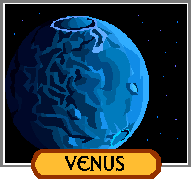
Venus is the brightest planet in our sky and can sometimes be seen with the naked eye if you know where to look. It is the solar system's brightest planet -- yellow clouds of sulfuric acid reflect the sun's light.
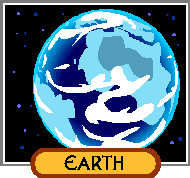
Earth has more exposed water than land. Three quarters of the Earth is covered by water! The earth has one moon.

Mars is the home of "Olympus Mons", the largest volcano found in the solar system. It stands about 27 kilometers high with a crater 81 kilometers wide.
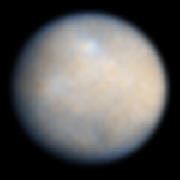 Between Mars and Jupiter, is a
Dwarf Planet known as Ceres. It was discovered in 1801. It is the
smallest dwarf planet discovered in our universe (so far) and is the only one
found in the asteroid belt. A dwarf planet is NOT a planet -- the solar system is made up of:
Between Mars and Jupiter, is a
Dwarf Planet known as Ceres. It was discovered in 1801. It is the
smallest dwarf planet discovered in our universe (so far) and is the only one
found in the asteroid belt. A dwarf planet is NOT a planet -- the solar system is made up of:
- a star (the sun),
- planets (ex: jupiter and earth),
- satellites (ex: the moon),
- dwarf planets (ex: Ceres and Pluto), and
- small solar system bodies (ex: asteroids and comets).

Jupiter is the largest planet in the solar system, but it spins very quickly on its axis. A day on Jupiter lasts only 9 hours and 55 minutes. Ack, I get dizzy just thinking about it!
Jupiter is so big that you could fit all the other planets in the solar system inside it.
The red spot of Jupiter is the biggest, most violent storm in the known universe -- that spot is at least three times the size of earth!
more about Jupiter >
(including actual photos)

Saturn is the second biggest planet, but it’s also the lightest planet. If there was a bathtub big enough to hold Saturn, it would float in the water!
The rings that surrounds Saturn could be the remnants of a moon that was shattered by Saturn's gravity. Saturn's rings are as wide as 22 planet earths all in a row but are only 30 feet thick!
more about Saturn >
(including actual photos)
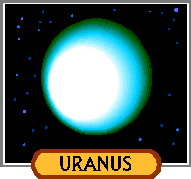
Uranus’ axis is at a 97 degree angle, meaning that it orbits lying on its side! Talk about a lazy planet.
Uranus has the second most complex set of rings in our solar system (Saturn has the most defined rings).
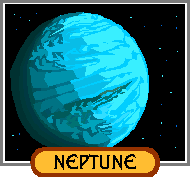
Neptune was discovered in 1846. In 2011 it finally made it's first lap around the sun since we discovered it -- because one Neptune year lasts 165 Earth years!
Like Jupiter, Neptune has a dark spot caused by a storm. Neptune's spot is smaller than Jupiter's -- it is only about the size of the planet earth.
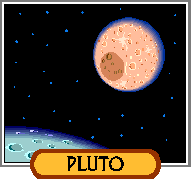
Pluto’s orbit sometimes brings it closer to the Sun than Neptune. It jumped ahead of Neptune on September 5, 1989 and remained there until February, 1999 when it went back to being the farthest.
Note: Pluto is no longer considered a planet -- instead, astronomers call it a dwarf planet or planetoid. Whatever the name, our solar system isn't the neat model we once thought it was. It takes a bit for grown-ups (like me!) to adapt to the changes in our understanding (I now understand a bit better how folks felt when someone started telling them the earth was round not flat!)

NASA photo
On July 14, 2015, the NASA space probe "New Horizons" finally made it to Pluto after its 9.5 year journey. It took lots of cool photos of Pluto and its moons and sent them back to us on Earth. Then it continued off into space -- who knows where it will end up!
To me, Pluto just keeps getting more awesome despite it losing its place as one of our planets (when I was young, it was my favorite). I love that thanks to projects like New Horizons, we now know that Pluto has a cute little heart shaped area on it. Yep... Pluto has a heart!

In January 2005, astronomers in the United States discovered a new body orbiting the sun in our solar system. They named this planetoid, Eris after the Greek goddess of strife.
Eris takes approximately 550 earth years to orbit the sun. The majority of the time, it is further from the sun than Pluto, but for a short time, it is closer.
Eris is actually larger than Pluto (it is the ninth largest object orbitting our sun discovered so far!)

Makemake and Haumea are dwarf planets just like Pluto, but a little further out in our solar system. Because their orbits are not perfect circles, they trade places in terms of which is closer and which is further from the sun.
Both were discovered in late 2004/early 2005.
Haumea has a squished egg shape -- thought to be the result of a collision from an asteroid or meteor at some time.

In 2004, astronomers in universities in the United States discovered a new body orbiting the sun in our solar system. They named this planetoid, Sedna after the Inuit goddess of the Ocean. This is the furthest orbiting body identified in our solar system to date.
Sedna is about three times further from our sun than Pluto. It takes between 10,500 and 12,000 earth years for Sedna to make one orbit around the sun (we haven't quite figured out exactly how long it takes).

the most beautiful craft I've ever seen!
Definition of a 'Planet': What makes something 'beautiful'? Is a Picasso painting beautiful? Or do you prefer a photograph? Or perhaps the first frog paper craft ever created by a beloved three year old is where beauty lies for you.
Definitions are created by people to describe the universe that surrounds us. But we don't have a 'King of Definitions' to tell us when we've got it right! Sometimes we all agree on what something means and sometimes we don't.
There is no 'King of Definitions' in charge of deciding what is a planet and what is not. These decisions are the result of a lot of thinking and conversation by a lot of very smart people. And these decisions change over time as our knowledge grows and changes.
Where we stand now, there are 8 'planets' in our solar system and a number of planetoids (dwarf planets). The biggest deciding factor that makes something a planet is that it orbits on the same plane, that it has significant gravity and that it is a large enough size.
It will be interesting to see how our solar system shapes up as astronomers discover more and more through technologies such as the Hubble Telescope!
Note: This section last updated in July 2015. Our understanding of our solar system is always being updated due to new technologies and new discoveries!