KidZone Science
Colored Carnations
What you need:
- 24 hours
- white carnations (1 would be enough, but you can get a few and do different colors)
- flower vase(s)
- food coloring
- water
- Optional: Colored Carnations Printable Activity Sheet
- Optional: Parts of a Plant Printable Activity Sheet
Directions:
- Fill vase 1/4 full of water.
- Add a fair amount of food coloring (10 to 20 drops) or more if your vases are large
- Put a flower in each vase and let it sit for a day. Just like you would for any cut flower, have an adult trim the stem at an angle before placing it in the vase
- Check back every few hours to see how it's working.
- At the end of your experiment, examine the whole plant carefully (stem,
leaves, buds, petals, etc). What parts can you see the food color in?
What Happened:
Most plants "drink" water from the ground through their roots. The water travels up the stem of the plant into the leaves and flowers. The plant uses the water to make food.
When a flower is cut, it no longer has it's roots. But the stem of the flower still "drinks" up the water and provides it to the leaves and flowers.
Note: Red and blue food coloring work the fastest.
Our Results:
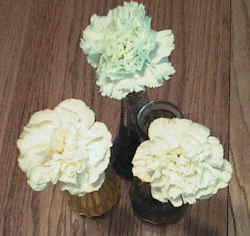
We (Tasha - Gr.3, age 9 and Kaitlyn - Kindergarten, age 5 and mommy, age 30-something *wink*) experimented with blue, yellow and green food coloring. The blue was the fastest and the green was the slowest. If your carnation doesn't start to show color in about 6 hours, add a few more drops of food coloring.
 Preparing the experiment |
 At the beginning |
After 6 hours |