Great Horned Owl
(Genus, species: Bubo virginianus)

We live in Alberta, Canada and we've often seen Great Horned Owls sitting on poles or gliding in the air as we drive around in our van. The Great Horned Owl was adopted as Alberta's provincial bird on May 3, 1977, by a province wide children's vote.

General: The Great Horned Owl is one of Canada's most common birds of prey (raptors) and lives here (and throughout North America) year round. This owl hunts only at night and is most easily identified by its large size and feathery ear tufts (horns). Most Great Horned Owls mate for life laying 1 to 5 eggs each year well before the snow melts.
The black area in the picture to the left represents the Great Horned Owl's living area. As you can see, it's extremely widespread.


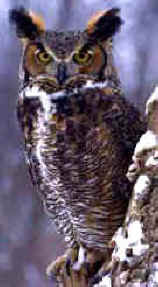
Description - male: Great Horned Owls are large owls -- about 18 to 25 inches long and have a wingspan between 35-60 inches. They have light gray to dark brown feathery ear tufts (which is how they ended up with the name 'Horned' owl).
They have horizontal breast barring with gray to brown, mottled bodies. Their face has a dark outline with a lighter brown center and sometimes a white bib under the chin. They have sharp, black talons and beaks.
They have large, round gold eyes. Like all owls, their large eyes cannot move. To look up, down or to the side the owls must move their entire heads and are able to turn their necks 180 degrees.
There are some differences in coloring of the Great Horned Owls, depending on where they live. But their ear tufts make them easy to identify.
Description - female: same as the male, but larger in size. The male weighs about 3 pounds while the female weighs about 4 1/2.
Description - young: The young owls are almost fully feathered and capable of short flights around eight weeks of age.

Feeding: Great Horned Owls hunt by perching or gliding slowly high above the ground. When they spot prey, they dive down to the ground with wings folded. The prey is usually killed instantly when grasped by the owl's large, curved talons.
Great Horned Owls are mainly nocturnal (meaning they hunt at night), but they also hunt during the day in the wintertime. They eat rodents, hares, squirrels, skunks, various birds such as geese, grouse, ducks and pigeons. They sometimes eat fish, large insects and scavenge road killed animals.
One of my 8 year old daughter's favorite science experiments in school was when the class got to dissect owl pellets. Owls eat their prey whole but cannot digest the fur, feather or bones. They periodically cough up pellets containing the undigested bits of their meal. In class the children picked out the bones from the pellet and worked at identifying what the meal had been. Tasha's owl pellet had the remains of a mouse.

Habitat: The Great Horned Owls are wide spread and have adapted to many different habitats. They are most often found in treed areas like forests, woodlands and shrublands.

Nesting: Great Horned Owls likely mate for life, beginning at 2 years of age. They have large territories which they both defend from others of their species. The territories need to be large to provide an adequate hunting area.
Great Horned Owls tend not to build their own nests. Instead they nest in the abandoned stick nests of another bird, on cliffs or occasionally even in hollow trees. Nesting occurs early in the spring, typically when the snow is still on the ground. The owls find a new nest each year since the young are so active that they virtually destroy their nests.
The female typically lays a clutch of 2 to 3 eggs each year (though it can be anywhere from 1 to 5 eggs). The male and female take turns sitting on the eggs ('incubating) for about one month.

Used with permission. © Robert McDonald
Thanks to Robert for allowing us to use this picture.
Enemies: The Great Horned Owl's only natural enemy is other Great Horned Owls, though occasionally other birds may try to get their eggs.
Migration: none, though they may wander a bit in search of prey.
 Worksheets and Other Activities:
- Alberta provincial bird (Great Horned Owl) Coloring Page
- Alberta provincial bird (Great Horned Owl) Coloring Page with labels
- Great Horned Owl Coloring Page (from coloring.ws)
- "What I've learned about the Great Horned Owl" Coloring Worksheet
- Help the Great Horned Owl find the prey Maze
- How many words can you make from GREAT HORNED OWL Word Worksheet